

Nitrous Oxide vs. Oral Sedation: What’s the Difference?
For some patients, the most difficult part of a dental appointment begins before treatment even starts. Anxiety about what will happen can make sitting in the dental chair feel challenging.
Sedation may be one way to make the experience more manageable for appropriate patients.
Premier Craft Dental Care offers two conscious-sedation options: nitrous oxide and oral conscious sedation. Both are intended to support patient comfort, but they work differently and require different considerations.
Understanding nitrous oxide vs oral sedation can help you have a more informed conversation with your dentist about which option, if either, may fit your needs.
The goal is not to identify one option as better. Sedation recommendations depend on the individual patient, planned treatment, medical history, medications, anxiety, and other circumstances.
What Is Nitrous Oxide Sedation?
Nitrous oxide sedation is an inhaled form of minimal conscious sedation.
It is sometimes informally called laughing gas.
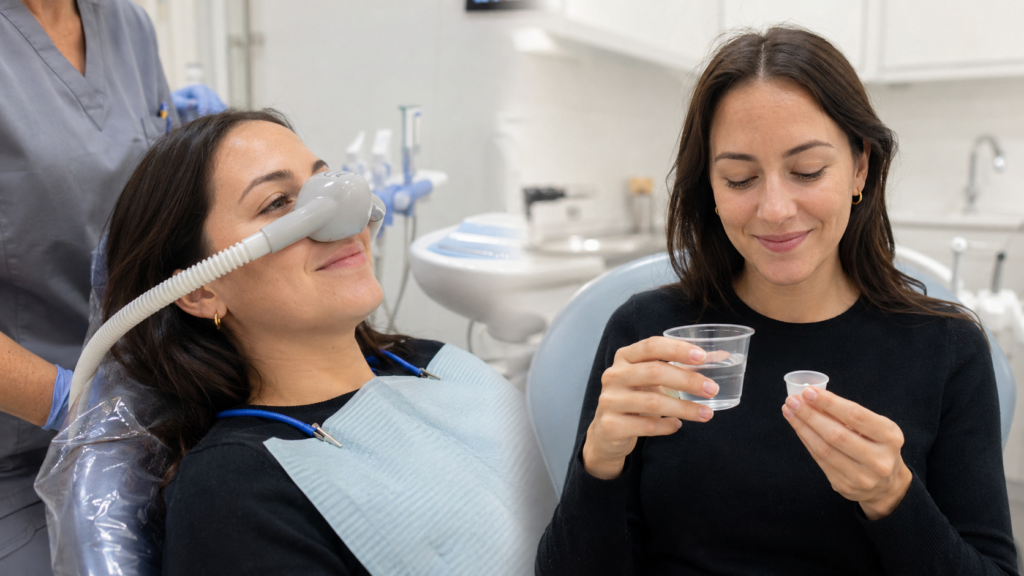
During treatment, nitrous oxide is delivered through a small mask placed over the nose. Appropriate patients remain awake and responsive while experiencing a greater sense of relaxation.
Because the patient remains conscious, communication with the dental team can continue throughout the appointment.
Nitrous oxide should not be confused with general anesthesia. It is intended to support relaxation rather than make the patient unconscious.
It also does not automatically eliminate the need for local anesthesia when numbing is appropriate for the procedure.
What Is Oral Conscious Sedation?
Oral conscious sedation involves taking sedative medication by mouth according to instructions from the dental team.
Premier Craft Dental Care’s client information describes oral sedation as potentially producing minimal to moderate sedation, compared with the minimal conscious sedation associated with nitrous oxide.
A patient may feel more relaxed or drowsy with oral sedation, but the exact experience varies.
Oral conscious sedation is still different from general anesthesia. It should not be described as guaranteeing that someone will sleep, lose awareness, or forget the entire appointment.
Because oral sedation can continue affecting alertness after treatment, patients need transportation home and should follow the specific preparation and aftercare instructions provided by the practice.
Nitrous Oxide vs. Oral Sedation: Key Differences
The easiest way to compare the two options is to look at how they are given and the general type of sedation involved.
| Nitrous Oxide | Oral Conscious Sedation | |
| How it is given | Inhaled through a mask over the nose | Sedative medication taken by mouth |
| General sedation level | Minimal conscious sedation | May produce minimal to moderate sedation |
| Consciousness | Patient remains awake and responsive | Patient remains conscious but may feel more relaxed or drowsy |
| Communication | Patient can remain responsive to the dental team | Responsiveness can vary with the level of sedation |
| Transportation home | Follow the dentist’s individual instructions | Transportation home is required |
| Local anesthesia | May still be used when appropriate | May still be used when appropriate |
These differences are useful, but they do not automatically determine which option is appropriate.
The dentist still needs to consider the patient and the treatment being planned.
Will I Be Awake During Dental Sedation?
Both options discussed here are forms of conscious sedation.
With nitrous oxide, appropriate patients generally remain awake and responsive throughout treatment.
Oral conscious sedation may produce greater relaxation or drowsiness, depending on the individual and clinical circumstances.
That does not make oral sedation the same as general anesthesia.
It is also better not to think of the comparison simply as one option being “stronger” than the other.
Nitrous oxide is categorized as minimal conscious sedation, while oral sedation may produce minimal to moderate sedation. The more important question is whether a particular level and method of sedation are appropriate for the individual patient.
Do I Still Need Local Anesthesia?
Possibly.
Sedation and local anesthesia have different purposes.
Sedation is used to support relaxation and help manage the patient’s overall experience.
Local anesthesia is used to numb a specific treatment area when appropriate.
Receiving nitrous oxide or oral sedation therefore does not automatically mean that the tooth or surrounding tissues will not need to be numbed.
Depending on the dental procedure, local anesthesia may still be part of the treatment plan.
Sedation should also never be presented as a guarantee of pain-free treatment.
Your dentist can explain which comfort measures are expected to be used for your specific procedure.
Which Option May Be Better for Dental Anxiety?
There is no universal answer.
Some patients may feel comfortable with nitrous oxide because it provides minimal conscious sedation while allowing them to remain awake and responsive.
Other patients may be candidates for oral sedation when a different level of relaxation is appropriate.
The decision should not be based only on which option sounds more powerful.
A dentist may consider the patient’s anxiety level, previous dental experiences, planned procedure, medical history, current medications, and ability to tolerate treatment.
Sedation is also only one part of helping an anxious patient feel comfortable.
Clear explanations, extra time, the ability to ask questions, a calm environment, and a judgment-free dental team can all contribute to the experience.
How Does a Dentist Choose the Right Sedation Option?
Before recommending sedation, the dentist needs to determine whether it is appropriate in the first place.
Factors may include:
- Level of dental anxiety
- Type of treatment being planned
- Medical history
- Current medications
- Previous dental experiences
- Ability to tolerate treatment
- Individual comfort needs
- Other relevant clinical considerations
These factors help determine whether nitrous oxide, oral sedation, another comfort approach, or no sedation may be appropriate.
This is why patients should not choose a sedation method simply because someone else had a positive experience with it.
The recommendation should be individualized.
What Should I Know Before Nitrous Oxide or Oral Sedation?
Preparation can differ depending on the sedation method and individual treatment plan.
With nitrous oxide, the dental team can explain how the inhaled sedation will be used and what to expect during the appointment.
For oral sedation, following the practice’s instructions is particularly important because the medication can affect alertness beyond the procedure. Transportation home must be arranged.
Do not assume that general preparation advice found online applies exactly to your appointment.
Your dentist should provide instructions based on the sedation method being used, your health information, and the treatment being planned.
Is Sedation Appropriate for Everyone?
No.
Having dental anxiety does not automatically mean sedation is necessary or appropriate.
Likewise, undergoing a more involved dental procedure does not automatically mean you need sedation.
The dentist considers the patient’s individual circumstances before recommending an option.
Some patients may benefit from additional sedation support. Others may feel comfortable with communication, local anesthesia when needed, and other comfort measures.
The objective is not to use sedation simply because it is available.
It is to decide whether it adds appropriate value to the patient’s treatment experience.
What Questions Should I Ask Before Dental Sedation?
You do not need to decide which sedation method you want before speaking with your dentist.
Useful questions include:
- Why are you recommending this option?
- What level of sedation should I expect?
- Will I remain awake and responsive?
- Will local anesthesia also be needed?
- How should I prepare for the appointment?
- Will I need transportation home?
- What instructions should I follow afterward?
- What should I do if I feel uncomfortable or anxious?
These questions can help you understand the reasoning behind the recommendation instead of simply choosing the option that sounds strongest.
Comfort Starts With More Than Sedation
Medication alone does not create a comfortable dental experience.
Premier Craft Dental Care emphasizes judgment-free care, honest communication, patient education, and personalized recommendations. These qualities can be particularly meaningful for patients who feel anxious about treatment or who have delayed dental care.
Sedation can be one part of the approach when clinically appropriate.
Listening to the patient, explaining what to expect, and giving the patient an opportunity to ask questions are also important.
Choosing the Sedation Option That Fits Your Needs
Nitrous oxide and oral conscious sedation can both support patient comfort, but they are not interchangeable.
Nitrous oxide is inhaled and provides minimal conscious sedation, with the patient remaining awake and responsive.
Oral conscious sedation is taken by mouth and may produce minimal to moderate sedation, including greater relaxation or drowsiness for some patients. Transportation home is required afterward.
Neither option is automatically better.
The appropriate decision depends on the individual patient, planned treatment, health history, medications, anxiety, and other relevant factors.
At Premier Craft Dental Care, sedation is part of a broader commitment to helping patients feel informed, respected, and involved in their care.
If you are considering sedation for an upcoming dental appointment, contact Premier Craft Dental Care to discuss your concerns and learn which comfort options may be appropriate for you.